Showing posts with label Kazakhstan. Show all posts

Monday, July 29, 2013

Kazakhstan


Kazakhstan 10 Tenge 1993
Front: Bust of Shoqan Valikhanov Walikhanuli (1835-1865)
Back: Mount Okzhetpes in Borovoye

Shoqan Shynghysuly Walikhanov given name Muhammed Qanafiya (November 1835 — April 10, 1865) was a Kazakh scholar, ethnographer, historian and participant of The Great Game. He is regarded as the father of modern Kazakh historiography and ethnography. The Kazakh Academy of Sciences is named after him. His name is written Shoqan Walikhanov in English based on the transliteration of the Russian spelling of his name, which he used himself. The Kazakh language variant of his name was written in the Arabic script, and was similar to the Russian version. His work combined military intelligence and geographic exploration. His first successful expedition was his 1855-56 mission to the region of Issyq Köl. He was afterwards called to the capital in St. Petersburg in 1857 to report, and there he was elected to the Russian Geographical Society. Read more

Portrait of Shoqan Walikhanov made in St. Petersburg by I. A. Kardovsky
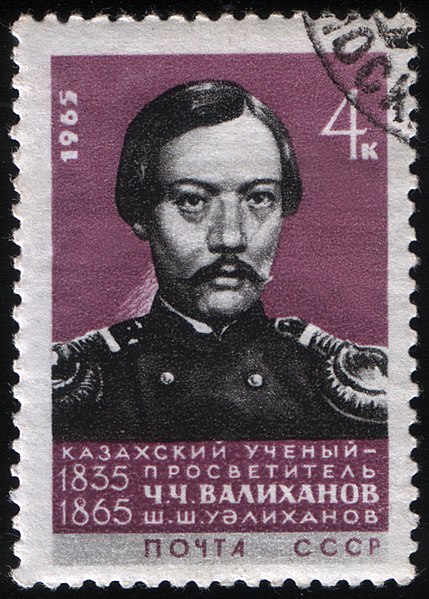
Shoqan Walikhanov on a 1965 Soviet commemorative stamp.
Information and Image Obtained From Wikipedia, the free encyclopedia

Wednesday, September 23, 2009

Kazakhstan


Kazakhstan 200 Tenge 1999 VF
Front: Abū Naṣr al-Fārābi
Back: Domes

Tuesday, September 22, 2009

Kazakhstan


Kazakhstan 500 Tenge 1999 VF
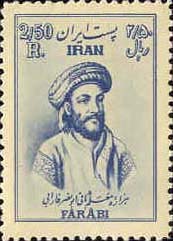
Front: Abū Naṣr al-Fārābi, between 14 December 950 and 12 January 951, was a Persian polymath and one of the greatest scientists and philosophers of Persia and the Islamic world in his time. He was also a cosmologist, logician, musician, psychologist and sociologist.
Back: Mausoleum of Khoja Ahmed Yasawi

An Iranian stamp from 1950 with Al-Farabi's imagined face.
Name: Abū Naṣr Muḥammad ibn al-Farakh al-Fārābi[1]
Title: The Second Teacher[2]
Birth: c. 872[2]
Death: c. 950[2]
Region: Central Asia, Iran, Egypt and Syria
Maddhab: Twelver Shi'a Muslim[2]
School tradition: known as "Father of Islamic Neoplatonism"; gave rise to the Farabian school[1]
Main interests: Metaphysics, Political philosophy, Logic, Music, Science(Tabi'iat), Ethics, Mysticism[2], Epistemology and Medicine
Works: kitāb al-mūsīqī al-kabīr ("The Great Book Of Music"), ārā ahl al-madīna al-fāḍila ("The Virtuous City"), kitāb iḥṣāʾ al-ʿulūm ("On The Introduction Of Knowledge"), kitāb iḥṣāʾ al-īqā'āt ("Classification Of Rhythms")[2]
Influences: Aristotle, Plato, Porphyry, Ptolemy,[citation needed], Al-Kindi
Influenced: Avicenna, Yahya ibn Adi, Abu Sulayman Sijistani, Shahab al-Din Suhrawardi, Ibn Bajjah, Mulla Sadra

Al Amiri, Averroes, Maimonides and Abū Hayyān al-Tawhīdī, Leo Strauss
Read more

A view of the mausoleum, ca. 1390.

The Mausoleum of Khoja Ahmed Yasawi (1103-1166) an unfinished mousoleum. The mausoleum has survived as one of the best-preserved of all Timurid constructions. Its creation marked the beginning of the Timurid architectural style. The religious structure continues to draw pilgrims from across the region and has come to epitomize the Kazakh national identity. It has been protected as a national monument, while UNESCO recognized it as the country’s first site of patrimony, declaring it a World Heritage Site in 2003. Read more

Information and Image Obtained From Wikipedia, the free encyclopedia

Thursday, August 6, 2009

Kazakhstan


Kazakhstan 5Tenge UNC 1993
Front: Kurmangazy Sagyrbaev
Back: Mausoleum complex

Kurmangazy Sagyrbaev (1823–1896), was a Kazakh composer, instrumentalist, and folk artist. He is buried in the Astrakhan region of Lower Volga in today's Russian Federation.

Stamp of Kazakhstan devoted to Kurmangazy Sagyrbayuly, 1998

Information and Image Obtained From Wikipedia, the free encyclopedia

Kazakhstan


Kazakhstan 3Tenge UNC 1993
Front: Aronuly Suinbai
Back: Mountain river; Alatau mountains

Aronuly Suinbai (1815-1898) he is a famous poetic, outstanding and brilliant representatives of a democratic. His creative work reflects the history and traditions, and life and morals of the Kazakhs, and is imbued with enthusiasm for the struggle for justice and a belief in future of his people.

Tuesday, March 31, 2009

Kazakhstan


Kazakhstan 200 Tenge UNC
Obverse: The images are vertical. In the center of the note is the Astan-Baiterek monument. In the middle of the banknote a fragment of music of the Kazakhstan National Anthem is printed in white on blue, brown and green stripes. Over the fragment of music is the white outline of the value numeral. To the left of the monument the Kazakhstan National Emblem is printed in green. The Kazakhstan National Flag is on the top right of the note. On the lower half of the note is an open hand. The face value, in Kazakh script, is shown vertically in the lower right corner. The name of the issuing bank, in the Kazakh language, is under the Kazakhstan National Anthem. Beneath the bank’s name is an inscription in Kazakh stating that counterfeiting banknotes is against the law.

Reverse: The images are horizontal. The main image is an outline map of Kazakhstan. In the foreground is the building of the RK Transport and Communication Ministry and a winged snow leopard on the bridge over the river Ishim in the capital Astana. In the background is the building of the RK Ministry of Defense and the steppes. The value numeral is shown both on the lower left corner and upper right corner. The face value, in Russian script, is shown in the middle of the lower half of the note. The name of the issuing bank, in the Kazakh language, and the bank’s logo are in the middle of the upper half of the note. In the top left corner, on the white area, there is an inscription in Russian stating that counterfeiting banknotes is against the law.
Information Obtained from National Bank of Kazakhstan


Bayterek, a symbol of the new Astana.
Bayterek (Kazakh: Бəйтерек, "tall poplar [tree]"), is a monument and observation tower in Astana, the capital of Kazakhstan. A tourist attaction popular with foreign visitors and native Kazakhstanis alike, it is a common symbol of the city and itself in turn symbolizes Astana's new status as the capital of Kazakhstan

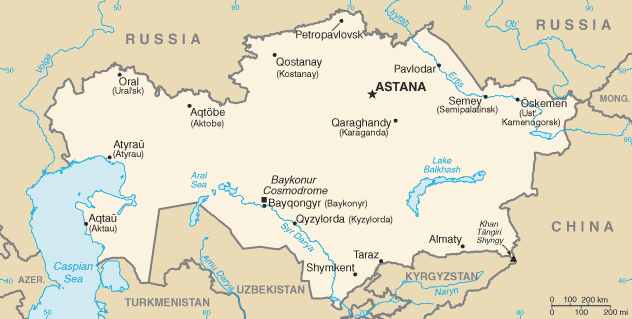
Map of Kazakhstan

Information and Image Obtained From Wikipedia, the free encyclopedia
Related Posts with Thumbnails